
About Chitwan National Park
Discover Chitwan’s forests, river habitats, wildlife and Tharu cultural experiences.
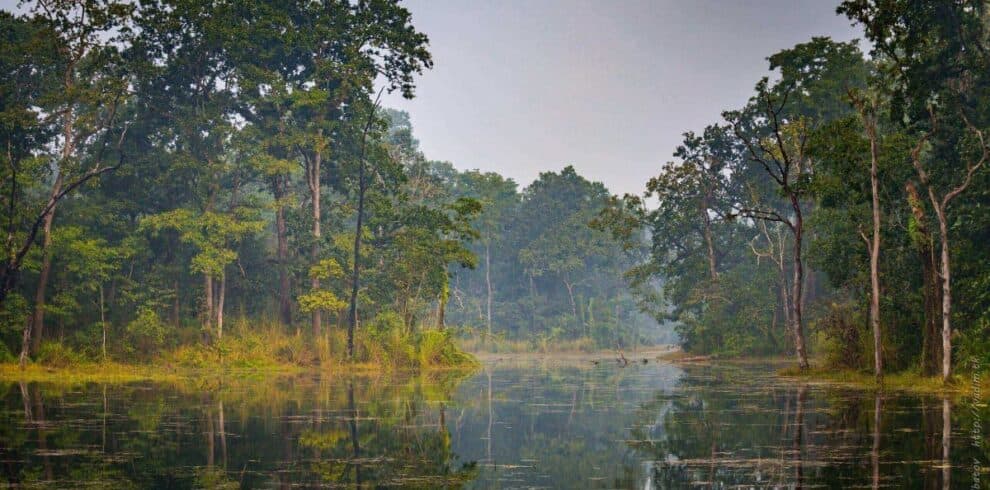
Chitwan National Park
Chitwan National Park is Nepal’s first and most famous national park, and it sits in the Inner Terai lowlands of Chitwan. Covering an area of 952.63 sq. kilometres, the park takes in the hilly areas of the Shivalik Range, which are covered in deciduous trees. Parts of the park are floodplains of the Narayani, Rapti and Reu rivers, thick with tall elephant grass and forests of silk cotton, acacia and Sisam trees. Chitwan National Park was officially established in 1973 and was listed as a World Heritage Site in 1984.
Chitwan National Park is a refuge for some of Asia’s last endangered species, such as the one-horned rhinoceros and the Royal Bengal tiger. You’ll also find the leopard, sloth bear, wild boar, rhesus monkey, grey langur monkey, wild dog, small wild cats, bison, the four species of deer and plenty of smaller animals. In fact, Chitwan National Park is home to 450 species of bird, which makes it ideal for bird watching. In summer the forest comes alive with nesting migrants such as the fabulous paradise flycatcher, the Indian pitta and parakeets.
On top of all that, there are a number of jungle safari excursions to choose from, including the Canoe ride, Chitwan Tharu Cultural Show, Chitwan Tharu Village Tour, Sunset Viewing and a Bicycle Tour to the Chitwan Elephant Breeding Centre.
Climate
The park has a range of climatic seasons, and each one offers something different. From October through February, average temperatures of 25°C make for a pleasant climate. From March to June, temperatures can climb as high as 43°C. Those hot, humid days then give way to the monsoon season, which usually lasts from late June until September, when the rivers flood and roads become impassable.
In late January, local villagers are allowed to cut thatch grass for their own needs, which, happily for visitors, makes the wildlife much easier to see. Between September and November, and again between February and April, migratory birds join the resident birds and create spectacular bird watching opportunities. While the monsoon rains bring lush vegetation, most trees flower in late winter. The palash tree, known as the “flame of the forest”, and the silk cotton tree both have spectacular crimson flowers that you can see from quite a distance.
Chitwan National Park has a tropical monsoon climate, with high humidity all year round and three main seasons.
Summer
March to early June are the traditional hot months, with temperatures climbing steadily to a peak in May. In April, despite the heat of the day, the nights can be surprisingly cold. South-westerly winds prevail, and relative humidity is at its lowest in March.
Monsoon
Towards the end of May, the pre-monsoon storms arrive. Dark clouds gather in the afternoons, bringing thunder, lightning and high winds. When rain does fall, it usually comes as late-afternoon showers lasting perhaps only fifteen to twenty minutes. As May turns into June, the showers become more and more frequent.
Once the monsoon proper begins, around the middle of June, it’s another story. From then until late September, moisture-laden south-easterly winds sweep up from the Bay of Bengal and bring heavy rain: of the annual total of some 80 inches, more than 80 per cent falls in these three months.
Don’t worry, though: the rain isn’t normally continuous, and in any monsoon month there are often as many dry days as wet ones. Humidity during the monsoon is extremely high, however.
Winter
Winter lasts from October to the end of February. Cool northerly winds come down from the mountains, and this is the best time of year to see the Great Himalayan Range, with the air particularly clear in November.
January is the coldest month, with temperatures falling almost to freezing point, especially when it rains. From late November the relative humidity reaches 100 percent in the mornings, so there’s dewfall on December and January nights. In fact, the sound of drips falling off the trees in the morning is often mistaken for rain. After an especially chilly morning, it’s hard to believe the temperature will rise to 20-25 Celsius by the afternoon.
Services Provided
- Elephant ride through the jungle to see the one-horned rhinos and perhaps a Bengal tiger - Jungle walks - Boat trip in a dugout canoe on the Rapti River (if you’re lucky, you’ll spot a crocodile) - Early morning Bird watching - Ox and cart trip to visit local areas - Visiting Elephant Breeding Centre - Bicycle tour to the many lakes in the jungle, where all kinds of animals can be spotted - Jeep drive in the jungle for those who’d rather not cycle - Jeep transport to other destinations, including bus parks - Experience the music and dance of Nepal at the Tharu Culture Programme - One-day trek to Saktikhor Hill to see traditional hills and lakes - Visit to the Tharu Culture Museum
Forests, grasslands and rivers
Chitwan brings together forest, open grassland and the river landscapes of Nepal’s southern lowlands. A visit here can mix wildlife viewing with some quiet time by the water and an introduction to local life.
Wildlife experiences
Rhinos, deer, crocodiles and birds all feature in the park’s wildlife stories. Jeep drives, guided walks and river outings each give you a different view of these habitats. To be honest with you, sightings depend on conditions and are never guaranteed.
Culture beyond the forest
Tharu village visits and cultural performances add a human side to a safari itinerary. Do ask your guide about the traditions behind the music, dance and everyday life you come across.
Plan your visit
Choose your stay around your interests. Before you confirm your plans, ask the team about the current weather, park access and the pace of each outing.